

, Quick Answer
Yes, hair products can contribute to forehead acne, especially when oily or heavy formulas repeatedly touch the hairline and forehead. They can leave residue that contributes to clogged pores and small bumps. Switching products, keeping hair away from the face, and washing product residue from skin can help.
This article provides general skincare information and is not a diagnosis or substitute for professional medical advice.
Can Hair Products Cause Forehead Acne?
If you keep getting tiny bumps across your forehead or around your hairline, your skincare routine may not be the only thing to investigate. Can hair products cause forehead acne? Yes, they can, particularly when products contain oils or leave a heavy residue on skin.
The American Academy of Dermatology explains that shampoos, conditioners, styling products, gels, waxes, pastes, sprays, and pomades can contribute to breakouts when their ingredients reach the skin. These breakouts often appear as small bumps or whiteheads around the hairline, upper forehead, and sometimes the back of the neck.
The connection can be easy to miss. You may apply a styling product to your hair in the morning, while the residue slowly moves onto your forehead throughout the day. Sweat, hats, scarves, pillowcases, and repeated hair-to-skin contact can increase exposure.
This does not mean every hair product causes acne. It also does not mean an ingredient is automatically “bad” simply because it appears on an acne-prone skin checklist. Your skin can react differently from someone else’s.
The useful clue is location and timing.
If your forehead was mostly clear before starting a new hair product and you later developed closely packed bumps around the hairline, the product deserves attention.
The goal is not to throw away every conditioner or styling cream you own. Instead, learn how product residue reaches your skin, which ingredients deserve closer attention, and how to test changes without creating more irritation.
Why Hair Products Can Trigger Forehead Breakouts
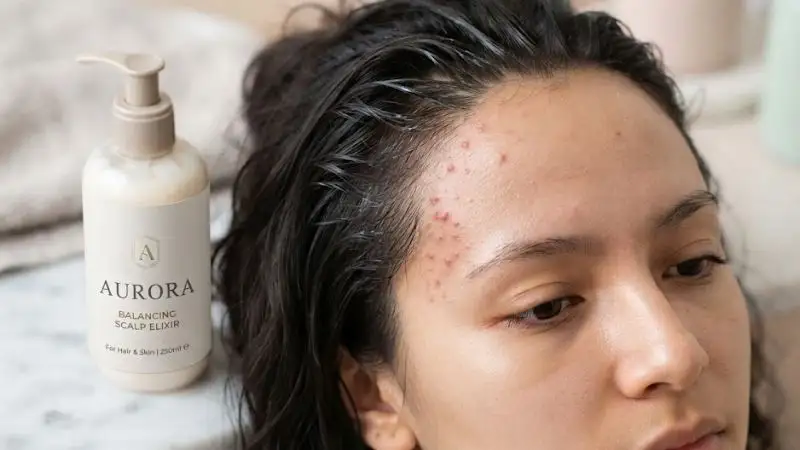
Hair products can contribute to acne when their ingredients transfer onto the skin and remain there. This matters most around areas where hair regularly touches the face.
Your pores naturally contain oil and shed skin cells. When oil, dead skin cells, and product residue collect around the follicle opening, the pore can become blocked. A blocked pore may develop into a whitehead or another type of acne lesion.
If you are wondering, can hair products cause forehead acne, repeated contact with oily or heavy formulas may be one possible reason for these breakouts.
What happens after product transfer?
- You apply the hair product.
Cream, oil, pomade, gel, wax, or conditioner stays on the hair. - The product reaches your skin.
Hair touches your forehead, or product spreads during styling. - Residue stays on the skin.
Sweat and natural oil can make the residue spread more easily. - Pores may become congested.
Some formulas can contribute to blocked pores, especially when they contain heavy oily components. - Small bumps or whiteheads may appear.
The breakout often stays concentrated near the hairline.
This pattern gives you a useful clue. If your cheeks and chin remain relatively clear while your hairline suddenly develops many tiny bumps, examine your hair routine before adding several new acne treatments.
You should also consider how you use the product. A conditioner that stays on your hair may be less likely to cause problems if you rinse it thoroughly and keep it away from your forehead. A leave-in cream or pomade placed directly near the hairline creates more opportunity for skin contact.
The same applies to hair oils. The AAD specifically recommends keeping oily hair products away from acne-prone areas and, when possible, applying hair oil mainly to the middle and ends of the hair rather than close to the scalp and face.
7 Hair Product Ingredients to Watch
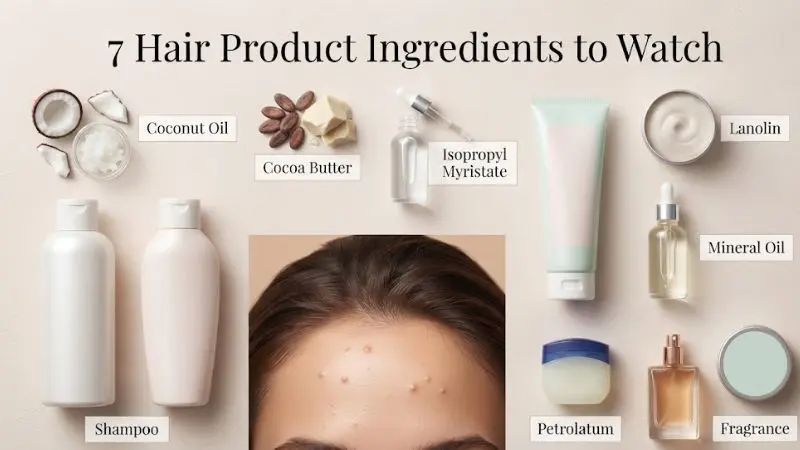
Understanding can hair products cause forehead acne also means knowing which hair product ingredients may contribute to clogged pores or irritation.
An ingredient can appear on a label without automatically causing a breakout. Formula concentration, product texture, how much you use, where you apply it, and your own skin can all affect the result.
Still, certain ingredients or ingredient groups deserve extra attention if you repeatedly develop forehead or hairline bumps.
| Ingredient or group | Why to watch it | What to do |
| Coconut oil | Heavy oils may be problematic for some acne-prone users | Keep it away from the forehead |
| Cocoa butter | Rich emollient that may feel heavy on acne-prone skin | Avoid face contact if you notice congestion |
| Isopropyl myristate | Can be highly comedogenic in some formulations | Consider a lighter alternative |
| Lanolin | Rich, occlusive ingredient that may not suit everyone | Monitor for bumps or irritation |
| Mineral oil | Creates an occlusive layer; acne response varies by formula | Watch your skin rather than assuming it is always harmful |
| Petrolatum | Very occlusive; usually used to reduce water loss | Avoid unnecessary transfer to acne-prone areas |
| Fragrance | More commonly linked with irritation or sensitivity than acne itself | Consider fragrance-free products if your skin reacts |
1. Coconut Oil
Coconut oil can feel nourishing on dry hair, but that does not mean it works equally well on acne-prone facial skin. If a coconut-oil-containing hair product repeatedly touches your forehead, monitor the area for new congestion.
You do not necessarily need to avoid coconut oil completely. The practical step is to keep it away from your face and see whether your forehead improves.
2. Cocoa Butter
Cocoa butter is a rich moisturizing ingredient. Some people with acne-prone skin may find rich formulas too heavy, particularly when they remain on the skin.
If a hair cream containing cocoa butter touches your forehead every day, consider moving the product farther down the hair shaft.
3. Isopropyl Myristate
Isopropyl myristate is used in cosmetic formulas to improve texture and spreadability. It has a reputation for being potentially comedogenic in some contexts.
Rather than treating the ingredient as automatically dangerous, use your own skin pattern as evidence. If small bumps consistently appear after using a product containing it, switching formulas may be reasonable.
4. Lanolin
Lanolin is a rich emollient derived from wool wax. It can help soften hair and skin, but some people may find rich products uncomfortable or irritating.
If your forehead becomes itchy, red, or bumpy after product exposure, stop using the suspected product and monitor the area.
5. Mineral Oil
Mineral oil is often misunderstood. It is not automatically an acne-causing ingredient. Its effect depends on the product and how your skin responds.
However, if a very rich mineral-oil-based hair product constantly transfers to your forehead, it may contribute to a heavy product layer. Keep it on the hair rather than allowing it to spread onto your face.
6. Petrolatum
Petrolatum forms a protective barrier that reduces water loss. That property can be useful for dry skin and damaged areas.
But you do not need a thick petrolatum-based hair product sitting along your forehead. If your styling product leaves a greasy film on the hairline, choose a lighter formula or apply less.
7. Fragrance
Fragrance is slightly different from the ingredients above. Fragrance does not automatically cause clogged pores, but it can irritate sensitive skin or trigger contact dermatitis in susceptible people. The FDA notes that cosmetic fragrances can cause allergic reactions in some individuals.
If your forehead feels itchy, burns, becomes red, or develops a rash rather than typical acne bumps, irritation may be a better explanation than clogged pores.
How to Tell If Your Hair Product Is Causing Forehead Acne
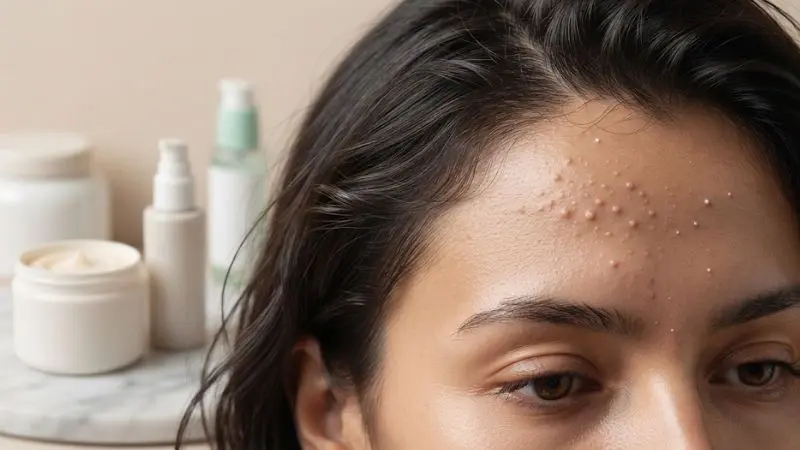
Knowing can hair products cause forehead acne is useful, but identifying whether they are actually causing your breakouts is even more important.
Look for a recognizable pattern rather than blaming the newest ingredient immediately.
Hair-product-related acne often appears:
- Along the hairline
- Across the upper forehead
- Near the temples
- On areas touched by oily hair
- As many small bumps or whiteheads
- After regular use of a styling product
- In an area where your skincare routine has not changed
The AAD reports that hair-product breakouts can produce whiteheads and small flesh-colored bumps and may appear around the hairline and forehead.
Use the Product-Change Test
Step 1: Identify one suspect product.
Start with your newest or heaviest leave-in product, pomade, oil, wax, or styling cream.
Step 2: Stop unnecessary forehead contact.
Do not apply the product near your hairline. Keep it on the lengths and ends when possible.
Step 3: Keep the rest of your routine stable.
Do not introduce three new acne treatments at the same time. Otherwise, you will not know what helped or irritated your skin.
Step 4: Clean product residue.
Wash your face gently after your hair routine if product has touched your forehead.
Step 5: Give your skin time.
Do not expect overnight results. The AAD says acne caused by hair products can take around 4–6 weeks to clear after the problematic product is stopped.
Step 6: Reassess the pattern.
If your forehead gradually improves while your overall routine remains stable, the product becomes a stronger suspect.
This approach is more useful than changing everything at once.
How to Prevent Hair Products From Causing Forehead Acne
The easiest way to reduce hair-product-related breakouts is to reduce unnecessary contact between your hair products and facial skin.
Knowing can hair products cause forehead acne can help you make simple changes to your daily hair routine.
Apply creams, oils, gels, and styling products mainly where you need them. If the ends of your hair need moisture, there is little reason to coat your forehead or hairline with the same product.
Wash your hands after applying heavy styling products. This simple step prevents you from accidentally transferring residue to your face.
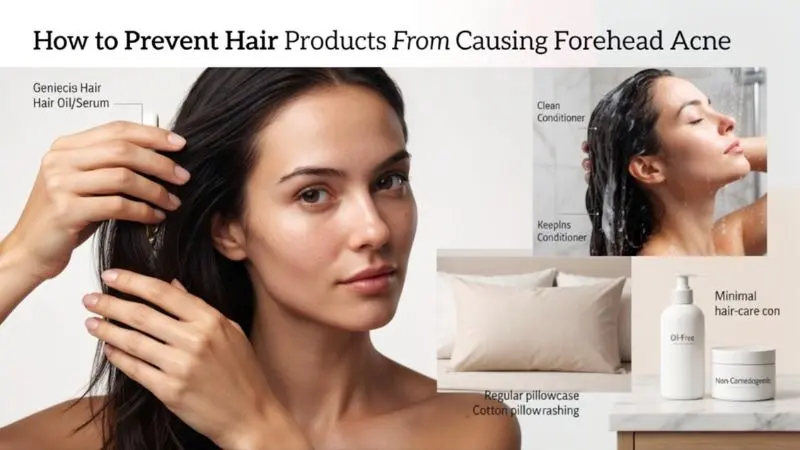
If you condition your hair in the shower, rinse thoroughly. Try tilting your head backward while rinsing so the product does not repeatedly run across your forehead.
Your pillowcase also matters. Hair products can transfer to fabric during sleep. The AAD recommends washing items that your head touches, including pillowcases, sheets, caps, hats, and headbands, when dealing with hair-product-related acne.
Choose labels carefully. AAD recommends looking for terms such as oil-free, non-comedogenic, non-acnegenic, or “won’t clog pores” when choosing products for acne-prone skin.
If you’re asking can hair products cause forehead acne, simple changes like keeping styling products away from your forehead can reduce unnecessary contact.
GlowVixa Product-Contact Checklist
☐ Apply hair oil mainly to the lengths and ends
☐ Keep styling products away from the forehead
☐ Wash hands after styling
☐ Rinse conditioner thoroughly
☐ Clean product residue from the hairline
☐ Wash pillowcases regularly
☐ Avoid very heavy layers of styling products
☐ Look for non-comedogenic or oil-free options when possible
☐ Change only one suspected product at a time
☐ Give the skin several weeks to show improvement
What Should You Use Instead?
If you suspect a hair product is contributing to forehead acne, you do not need to stop caring for your hair.
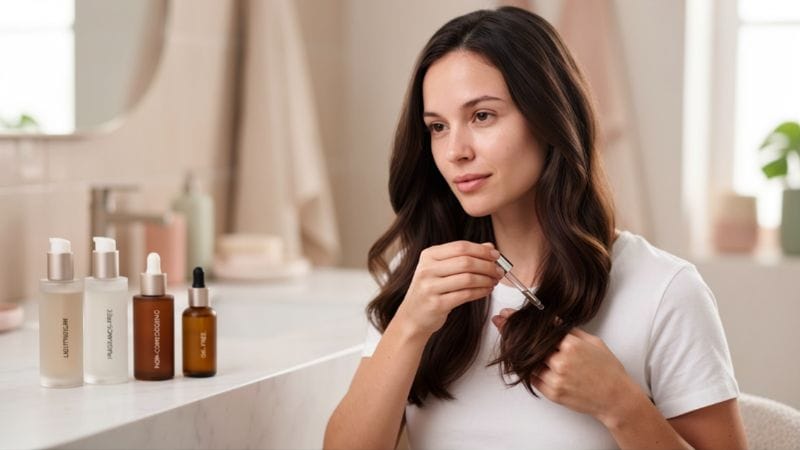
The better approach is to choose lighter formulas and change how you apply them.
Look for products that feel lightweight and do not leave a thick greasy film along your hairline. If your hair needs oil, concentrate it on the mid-lengths and ends instead of the roots and areas touching your forehead.
For styling products, use the smallest amount that gives you the result you want.
If your skin is sensitive, consider fragrance-free options. Fragrance is more relevant to irritation and allergic reactions than to clogged pores, so this change can be particularly useful if your forehead becomes itchy or red.
You can also simplify your routine for a few weeks.
Simple Hair + Skin Routine
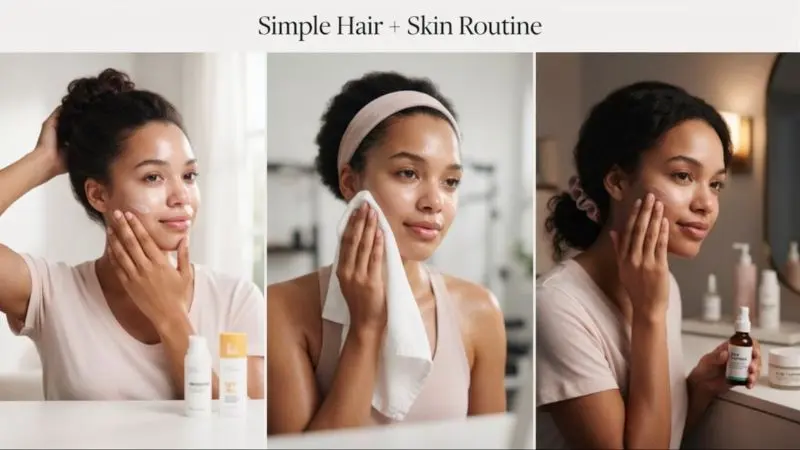
Morning
- Style your hair before completing your facial skincare.
- Wash your hands after using hair products.
- Gently cleanse the forehead if product has transferred to the skin.
- Apply a lightweight moisturizer suitable for acne-prone skin.
- Finish with broad-spectrum sunscreen.
After sweating
- Keep hair away from the forehead.
- Gently cleanse the face when practical.
- Avoid rubbing sweat and styling product into the skin.
Evening
- Remove makeup and sunscreen.
- Cleanse the forehead gently.
- Apply your usual acne treatment if you already use one.
- Moisturize.
- Keep heavily coated hair away from the face while sleeping.
Do not scrub the forehead aggressively to “remove clogged pores.” The AAD warns that irritating skincare practices can make acne appear worse.
If you want to compare your facial skincare choices with other acne-prone products, you can also review GlowVixa’s best tinted moisturizer for acne-prone skin guide, which discusses lightweight and non-comedogenic product selection.
What About Shampoo and Conditioner?

Shampoo and conditioner can also contribute to forehead or hairline breakouts because they come into direct contact with the areas around your hairline.
This does not mean you need an expensive “acne-safe” shampoo. Start by looking at how the product is used.
Conditioner usually needs more contact with the hair than the skin. Apply it mainly to the lengths and ends rather than rubbing it directly into your forehead.
Then rinse it thoroughly.
If you ask can hair products cause forehead acne, remember that shampoo and conditioner can also reach the forehead during washing and rinsing.
If you are asking can hair products cause forehead acne, remember that shampoo and conditioner can also come into contact with the forehead and hairline.
Your Hair Product Trigger Tracker
For two to four weeks, record:
| What to track | What to notice | Why it matters |
| Product | Shampoo, conditioner, oil, gel, wax, cream | Identifies possible triggers |
| Location | Forehead, hairline, temples | Shows the breakout pattern |
| Texture | Tiny bumps, whiteheads, red pimples | Helps describe the reaction |
| Timing | New product or increased use | Connects exposure with changes |
| Improvement | Changes after stopping contact | Shows whether the product may matter |
Keep your notes simple. You do not need to track every ingredient in every product.
The most useful information is whether the same product repeatedly appears before the same type of breakout.
When Forehead Acne Is Probably Not From Hair Products
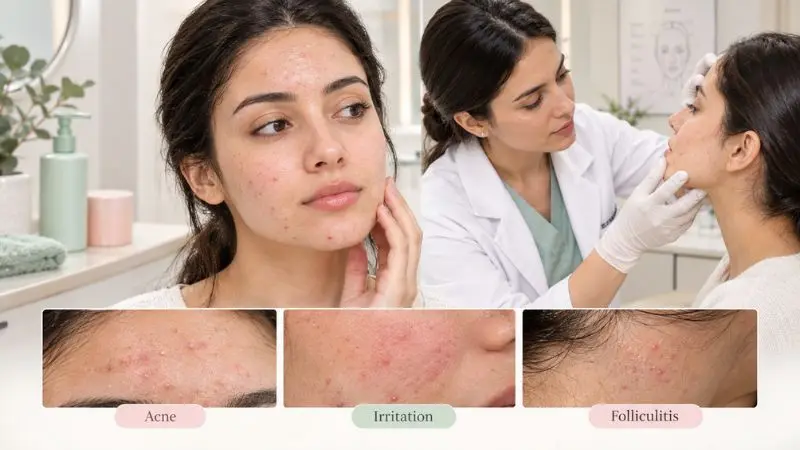
Hair products are only one possible cause of forehead acne.
Hormonal changes, excess oil, sweat, friction, skincare products, makeup, stress, and other factors can also contribute to breakouts.
If your acne appears across your cheeks, chin, jawline, and forehead, a hair product may not explain the entire problem.
You should also consider your skin routine. Adding several strong acne products can irritate the skin barrier and make your face feel dry, tight, or uncomfortable.
Another clue is the type of bumps.
Hair-product-related breakouts often show up as many small bumps or whiteheads around the hairline. A sudden painful deep cyst may have other causes and deserves more attention.
If your forehead becomes intensely itchy, swollen, burning, or develops a rash, think beyond acne. Cosmetic ingredients can trigger allergic or irritant reactions in some people. The FDA lists fragrance and certain preservatives among cosmetic ingredients that can cause allergic reactions in susceptible individuals.
Do not keep using a product that causes a significant reaction just to “test” whether it is responsible.
When to Stop a Product
Stop the suspected product and seek appropriate medical advice if you develop:
- Significant swelling
- Severe burning
- A spreading rash
- Blistering
- Severe itching
- Painful or rapidly worsening acne
- A reaction involving the eyes or lips
For persistent acne, a dermatologist can help determine whether you are dealing with acne, irritation, folliculitis, or another skin condition.
If your breakouts do not improve after removing the suspected hair product and simplifying your routine, professional evaluation becomes more useful.
How Long Does Hair-Product Acne Take to Clear?
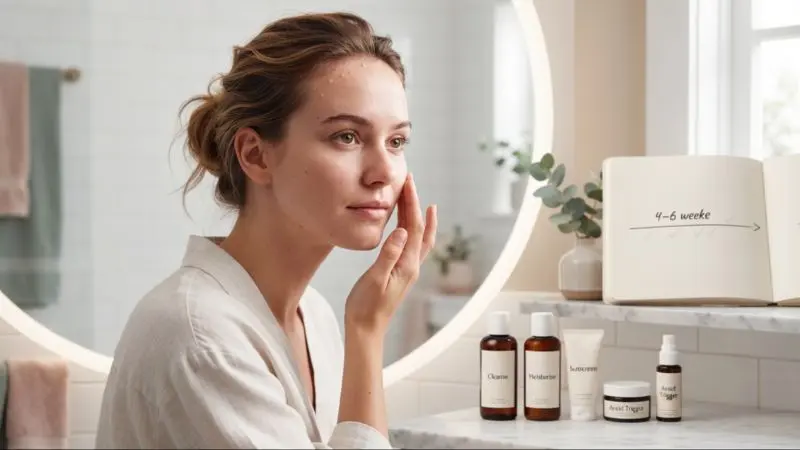
Hair-product-related acne does not usually disappear overnight.
The AAD says that after stopping the products responsible for breakouts, it can take approximately 4–6 weeks for the acne to clear.
That waiting period can feel frustrating, especially when you expect a new cleanser or serum to fix everything immediately.
Give your skin time.
During this period, avoid constantly changing products. Every new cleanser, exfoliant, spot treatment, and mask creates another variable.
Instead, use a simple routine:
Cleanse → moisturize → protect with sunscreen → avoid the suspected hair-product trigger.
If you already use an acne treatment recommended by a healthcare professional, continue following that plan unless you are told otherwise.
You should also avoid squeezing the bumps. Picking can increase inflammation and raise the risk of lingering dark spots and scars. The AAD recommends keeping your hands off acne and notes that picking or squeezing can increase the risk of scarring and post-inflammatory hyperpigmentation.
Patience is part of the process.
If your skin gradually improves after removing the suspected product, you have useful evidence that product exposure played a role.
If there is no improvement, do not assume you failed. It simply means another trigger may be involved.
Two Practical Frameworks for Acne-Prone Hair Care
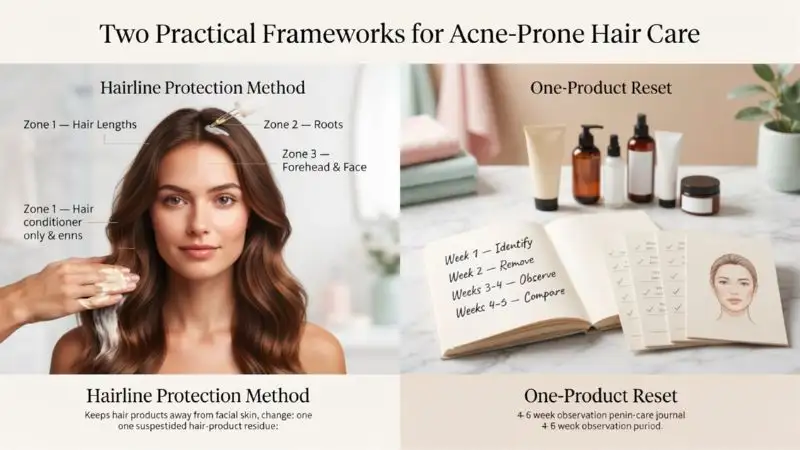
Framework 1: The Hairline Protection Method
Use this simple 3-zone system:
Zone 1 — Hair lengths:
Use richer conditioners, oils, and treatments here when needed.
Zone 2 — Roots:
Use only the amount of product your hair actually needs.
Zone 3 — Forehead and face:
Keep unnecessary hair products away from this area.
This method lets you care for dry hair without covering your facial skin in the same formula.
Framework 2: The One-Product Reset
When several hair products are involved, use this process:
Week 1: Identify your heaviest or newest product.
Week 2: Remove that product from the hairline and forehead.
Weeks 3–4: Keep your skincare routine stable and observe the breakout pattern.
Weeks 4–6: Compare your forehead with how it looked before the change.
If the bumps steadily decrease, the removed product becomes a stronger suspect.
If nothing changes, examine other causes instead of automatically blaming every ingredient.
This framework prevents the common mistake of changing shampoo, conditioner, moisturizer, cleanser, sunscreen, and acne treatment all at once.
Hair Product vs Forehead Acne: Quick Comparison
| Sign | More consistent with hair-product acne | May suggest another cause |
| Location | Hairline and upper forehead | Widespread face or jawline |
| Appearance | Tiny bumps or whiteheads | Deep cysts or mixed lesions |
| Timing | Started after product use | Started without hair-routine changes |
| Exposure | Product touches forehead | No obvious product contact |
| Improvement | Slowly improves after product removal | Continues despite product removal |
This table is not a diagnosis. It simply helps you recognize patterns worth discussing with a healthcare professional.
Final Forehead Acne Safety Checklist
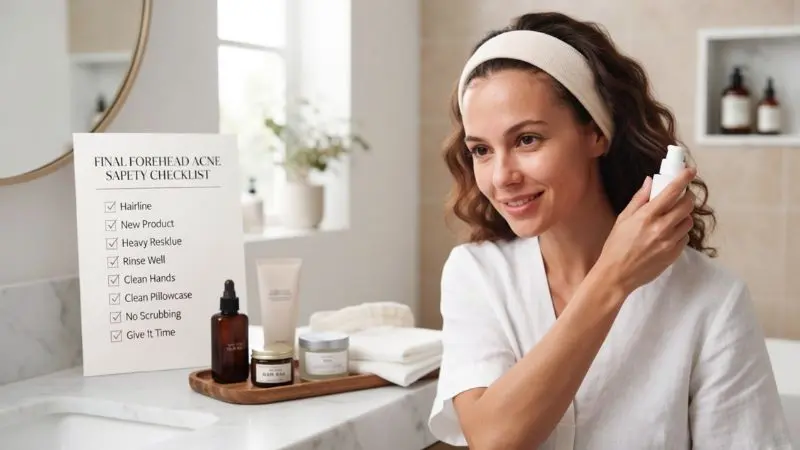
Before blaming your hair products, ask yourself:
☐ Did the bumps appear mainly around my hairline?
☐ Did I recently add a hair oil, pomade, gel, wax, or cream?
☐ Does my hair regularly touch my forehead?
☐ Does the product leave a greasy or heavy film?
☐ Do I apply product close to my roots or hairline?
☐ Do I rinse conditioner thoroughly?
☐ Do I wash my hands after styling?
☐ Do my pillowcase and headbands collect product residue?
☐ Am I avoiding aggressive scrubbing?
☐ Have I given the product change enough time to show results?
If you can answer “yes” to several of these questions, your hair routine deserves a closer look.
Frequently Asked Questions
Can hair products cause forehead acne?
Yes. Oils and residue from shampoos, conditioners, gels, waxes, and pomades can contribute to breakouts around the hairline and forehead.
What hair products commonly cause hairline acne?
Heavy oils, pomades, waxes, and styling creams may cause problems, especially when they regularly touch your forehead.
How long does forehead acne from hair products take to clear?
It can take around 4–6 weeks to improve after stopping the product causing the breakouts.
Should I stop using hair oil if I have forehead acne?
Not necessarily. Apply hair oil mainly to the middle and ends, keeping it away from your forehead and hairline.
When should I see a dermatologist for forehead acne?
See a dermatologist if acne is painful, persistent, worsening, scarring, or not improving after removing the suspected hair product.
.
Conclusion
So, can hair products cause forehead acne? Yes, they can contribute to breakouts, especially when oily or heavy products repeatedly touch the forehead and hairline. The good news is that this is often something you can investigate with simple changes.
Start by looking at your hair oils, pomades, waxes, styling creams, conditioners, and leave-in products. You do not have to assume that every ingredient is harmful. Instead, pay attention to rich formulas, product residue, and the location of your breakouts.
Keep heavier products on the hair rather than the skin. Apply oils mainly to the lengths and ends. Rinse conditioner well, wash your hands after styling, and keep your hair away from your face when possible. Cleaning pillowcases and other items that collect hair-product residue can also reduce repeated exposure.
Do not attack forehead bumps with harsh scrubs or several strong acne treatments at once. That approach can irritate your skin and make it harder to understand what is actually happening.
Give your skin time. Hair-product-related acne can take around four to six weeks to clear after the responsible product is removed.
Most importantly, remember that one breakout does not prove that an ingredient is the cause. Look for a consistent pattern, make one change at a time, and seek professional advice when acne is painful, severe, persistent, or leaving scars.
Small changes to your hair routine can sometimes make a surprisingly big difference to your forehead.




Leave a Reply