
Quick Answer
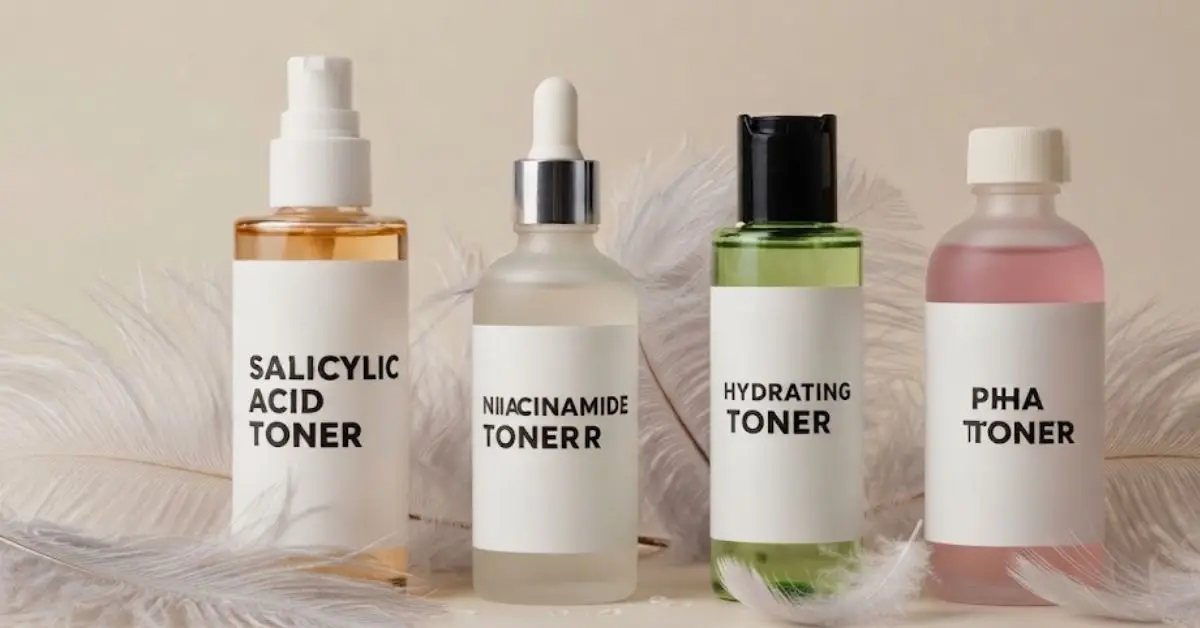
The best toner for acne-prone skin depends on your skin type and main concern. A salicylic acid toner may help clogged pores, blackheads, and excess oil, while a gentle hydrating or niacinamide toner may suit sensitive skin. Avoid harsh, alcohol-heavy toners that leave your skin dry or irritated.
Author Box
Author: Saira
Role: Publisher & Skincare Content Writer
Experience: 5+ Years researching skincare, acne care, and beauty content
Content Review: Evidence-informed skincare content based on trusted dermatology resources and practical skincare research.
Introduction
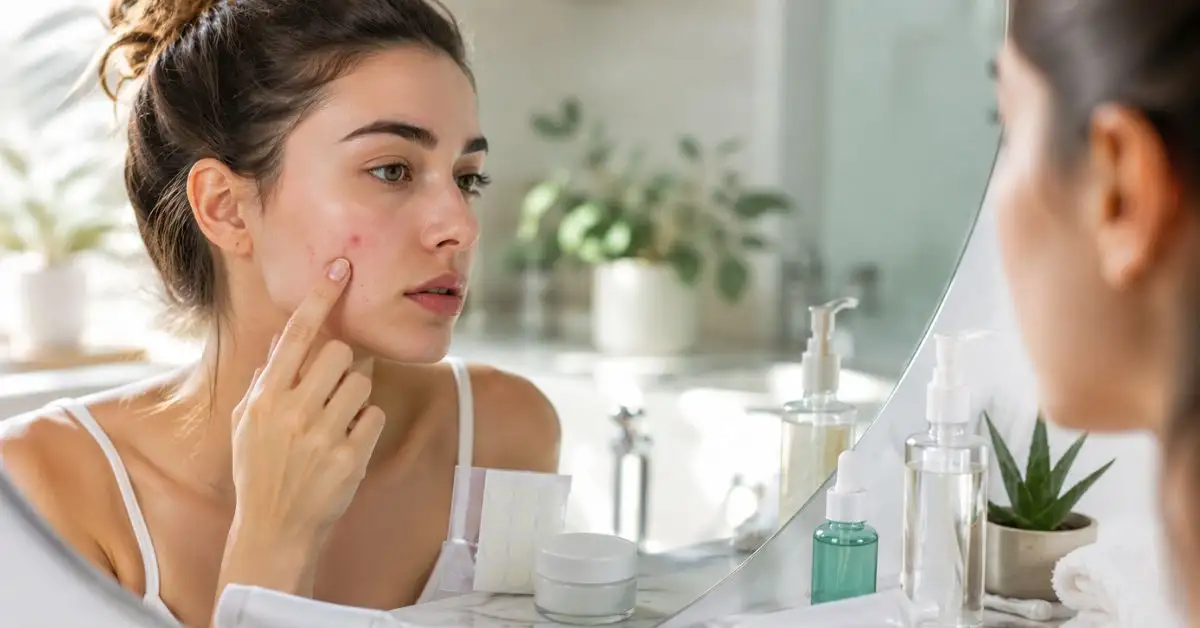
Finding the best toner for acne-prone skin can feel confusing because skincare shelves are filled with products that promise smaller-looking pores, less oil, fewer breakouts, and clearer skin. But not every toner belongs in an acne routine.
A toner is not automatically an acne treatment. Some formulas mainly add hydration, while others contain active ingredients such as salicylic acid that can help with clogged pores. The wrong formula, especially one that causes dryness or irritation, can make your routine harder to manage.
Acne-prone skin also needs balance. Removing every trace of oil may sound helpful, but harsh cleansing and irritating products can leave the skin uncomfortable and may make an acne routine difficult to tolerate. The best toner for acne-prone skin should not cause unnecessary irritation. The American Academy of Dermatology recommends gentle skincare and warns that irritating products, including some toners and exfoliants, can worsen acne.
In this guide, you will learn how toner works, which ingredients matter, how to choose one for oily or sensitive skin, how often to use it, and which mistakes to avoid.
What Is the Best Toner for Acne-Prone Skin?
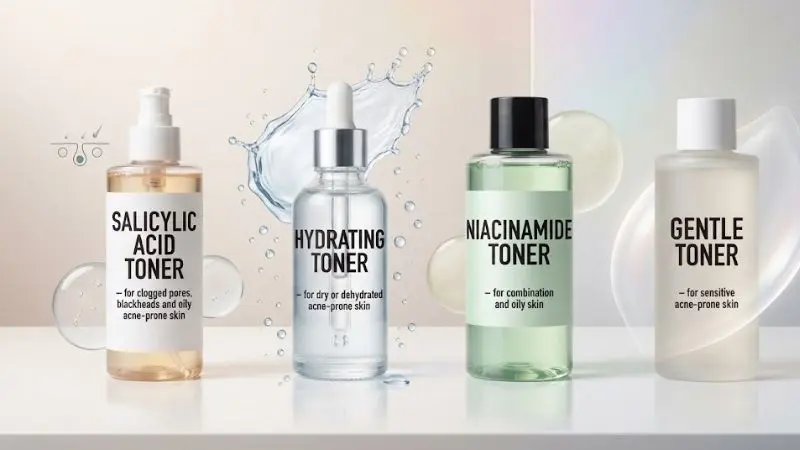
The best toner for acne-prone skin is one that matches your skin’s needs without causing unnecessary irritation. For clogged pores and blackheads, a toner containing salicylic acid may be useful. For sensitive or dehydrated skin, a simple hydrating toner may be a better choice.
A toner usually comes after cleansing and before moisturizing. Its role depends on its formula.
Some toners are designed mainly to hydrate the skin. Others contain ingredients that exfoliate, calm irritation, or support the skin barrier.
This difference matters because acne-prone skin is not one single skin type.
You might have:
- Oily and acne-prone skin
- Combination skin with clogged pores
- Sensitive acne-prone skin
- Dry skin with occasional breakouts
- Hormonal acne with an otherwise normal skin texture
Which Toner Ingredients Help Acne-Prone Skin?
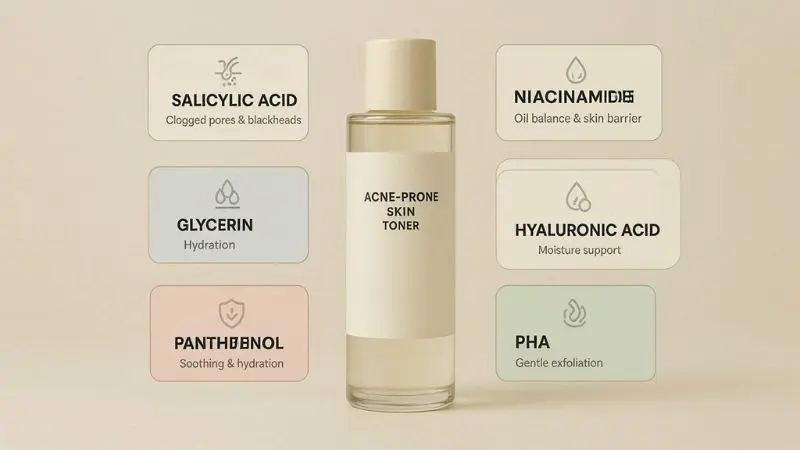
When choosing the best toner for acne-prone skin, look for ingredients that address your specific concern rather than choosing a product based only on its marketing claims
.When choosing the best toner for acne-prone skin, look for ingredients that target your specific concern instead of choosing a product based only on marketing claims.
Different ingredients perform different jobs.
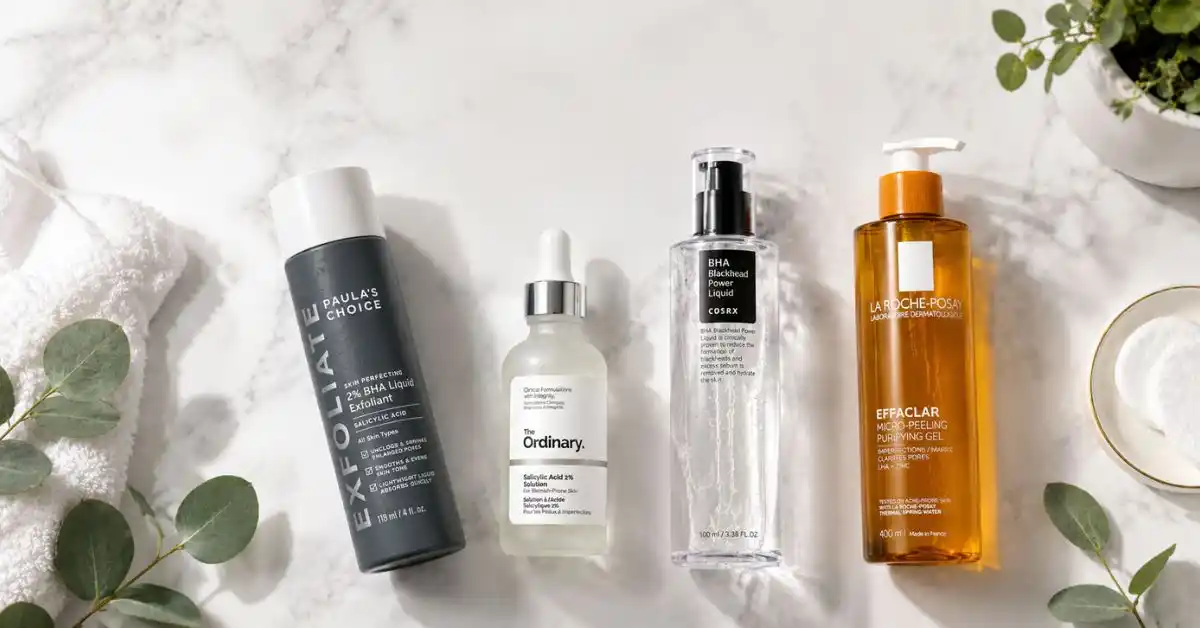
Salicylic acid is one of the most relevant ingredients for acne-prone skin because it can exfoliate and help unclog pores. The FDA lists salicylic acid among permitted OTC acne active ingredients, including concentrations from 0.5% to 2% under the acne monograph.
Niacinamide can be useful when you want a gentler formula that supports the skin barrier and helps with the appearance of excess oil and uneven tone.
Humectants, such as glycerin and hyaluronic acid, attract and hold water. They can make a toner more suitable for skin that feels dehydrated.
Panthenol can add a soothing and moisturizing function to some formulas.
PHA ingredients can provide gentler exfoliation than stronger acid routines, although tolerance still varies between people.
Ingredient Comparison
| Ingredient | Main purpose | Often useful for | Main caution |
| Salicylic acid | Exfoliation and pore unclogging | Blackheads, whiteheads, oily skin | Can cause dryness or irritation |
| Niacinamide | Barrier and oil-control support | Oily, combination, sensitive skin | Some people react to higher concentrations |
| Glycerin | Hydration | Dehydrated skin | Usually well tolerated |
| Hyaluronic acid | Hydration | Dry or dehydrated acne-prone skin | Choose a simple formula if sensitive |
| PHA | Gentle exfoliation | Sensitive skin | Still introduce gradually |
One important point: not every acne-prone person needs an exfoliating toner.
If your routine already includes a salicylic acid cleanser, leave-on BHA, retinoid, or another exfoliating product, adding another active toner may increase irritation.
Your skincare routine should work as a system rather than treating every concern with a separate active.
For example, if clogged pores are your main issue, one well-tolerated salicylic acid product may be more practical than combining several acids.
GlowVixa’s guide to the best exfoliator for acne-prone skin also explains how AHA, BHA, and PHA products differ and why over-exfoliation can create problems.
Is Salicylic Acid Toner Good for Oily and Acne-Prone Skin?
A salicylic acid toner can be a useful option for oily acne-prone skin, especially when blackheads, whiteheads, and clogged pores are major concerns.
.For oily skin with clogged pores, a salicylic acid formula may be a practical option when choosing the best toner for acne-prone skin.
Salicylic acid is a beta hydroxy acid, commonly called BHA. Unlike water-soluble exfoliating acids, it has oil-soluble properties that make it useful for acne-prone skin and clogged pores.
The AAD states that salicylic acid opens clogged pores and exfoliates the skin. It can be particularly useful for whiteheads and pimples.
But there is an important distinction between using salicylic acid appropriately and trying to dry out acne as quickly as possible.
A toner that makes your skin feel extremely tight is not automatically working better.
If you use a salicylic acid toner, introduce it gradually.
A Simple Salicylic Acid Introduction Framework
Step 1 — Start slowly
Use the product according to its label and begin with a lower frequency if your skin is sensitive.
Step 2 — Watch your skin
Look for persistent burning, redness, peeling, or discomfort.
Step 3 — Avoid stacking too many actives
Do not immediately combine several exfoliating products simply because you want faster results.
Step 4 — Moisturize
Use a suitable moisturizer after your active skincare.
Step 5 — Use sunscreen in the morning
A broad-spectrum sunscreen helps protect your skin while you manage acne and post-acne marks.
The FDA recognizes salicylic acid as an OTC acne active ingredient, but individual product directions still matter.
If your skin becomes irritated, reduce frequency or stop the product and simplify your routine.
What Is the Best Toner for Sensitive Acne-Prone Skin?
For sensitive acne-prone skin, the best toner may not be an exfoliating toner at all.
For sensitive skin, the best toner for acne-prone skin may be a gentle hydrating formula rather than a strong exfoliating toner.
A gentle, fragrance-free or low-irritant hydrating formula may be more appropriate if your skin frequently feels tight, burns easily, becomes red, or reacts to active ingredients.
Sensitive skin can become more difficult to manage when you repeatedly use strong products.
This creates a simple cycle:
Harsh toner → irritation → damaged-feeling skin → more products → more irritation
Instead, focus on maintaining a comfortable routine.
Look for:
- Gentle hydrating ingredients
- Glycerin
- Panthenol
- Hyaluronic acid
- Moderate niacinamide
- Fragrance-free formulas when fragrance irritates you
- Non-comedogenic products when available
Avoid assuming that every “cooling,” “deep cleansing,” or “pore tightening” toner is suitable for acne.
Alcohol-heavy formulas can feel refreshing because they evaporate quickly, but that sensation does not mean the product is improving acne.
The AAD recommends gentle skincare and advises people with acne to avoid products that irritate the skin.
If your skin is already irritated from acne medication or exfoliation, adding another active toner may not be the best next step.
Instead, temporarily simplify your routine:
Gentle cleanser → moisturizer → sunscreen
Once your skin feels comfortable again, you can decide whether a toner adds a useful function.
GlowVixa’s gentle acne guide for sensitive skin provides additional guidance on reducing irritation while managing breakouts.
How Should You Use Toner in an Acne Skincare Routine?
Using toner correctly matters just as much as choosing the formula.
Knowing how to use the best toner for acne-prone skin can help you avoid unnecessary irritation and keep your routine simple.
A toner generally goes after cleansing and before moisturizer or other leave-on skincare.
You do not need to use a toner simply because every skincare routine on social media includes one.
Morning Routine
- Gentle cleanser
Remove sweat, oil, and overnight skincare residue without aggressive scrubbing. - Toner, if useful
Apply your chosen toner according to its directions. - Treatment serum, if needed
Use only products that fit your routine. - Moisturizer
Choose a lightweight, non-comedogenic option if that suits your skin. - Broad-spectrum sunscreen
Apply SPF 30 or higher.
Evening Routine
- Cleanse gently.
- Apply toner if your skin tolerates it.
- Apply your acne treatment or other targeted product.
- Moisturize.
You do not need to wait for your skin to become completely dry before every hydrating product. Follow the directions of the specific product.
For acne-prone skin, consistency matters more than having a long routine.
A moisturizer can also be useful when acne treatments make the skin dry or irritated. The AAD recommends looking for labels such as oil-free and non-comedogenic when choosing moisturizers for acne-prone skin.
Toner Safety Checklist
☐ Choose ingredients based on your skin concern
☐ Patch test when appropriate
☐ Introduce active toners gradually
☐ Avoid aggressive scrubbing
☐ Do not combine multiple exfoliating products unnecessarily
☐ Moisturize when your skin feels dry
☐ Wear broad-spectrum sunscreen during the day
☐ Stop or reduce a product if significant irritation develops
☐ Do not use toner as a replacement for acne treatment
How to Choose a Toner for Oily, Dry, Combination, or Sensitive Skin
There is no single toner that works equally well for every acne-prone person.
Your skin type and main concern should guide your choice.
Finding the best toner for acne-prone skin starts with identifying your skin type and main concern, such as excess oil, clogged pores, dehydration, or sensitivity.
| Skin type or concern | Toner type to consider | Ingredients to look for | What to watch for |
| Oily + clogged pores | Exfoliating toner | Salicylic acid | Excess dryness |
| Blackheads | BHA toner | Salicylic acid | Irritation from overuse |
| Sensitive acne-prone | Hydrating toner | Glycerin, panthenol | Fragrance and harsh actives |
| Dehydrated acne-prone | Hydrating toner | Glycerin, hyaluronic acid | Heavy or irritating formulas |
| Combination skin | Gentle active or hydrating toner | Niacinamide, low-strength BHA | Using too many actives |
| Frequent irritation | Simple hydrating toner or no toner | Glycerin, panthenol | Burning or persistent redness |
Oily Skin
If your face becomes shiny quickly and you have clogged pores, a carefully used salicylic acid toner may fit your routine.
However, do not try to remove all oil.
The AAD notes that harsh products can irritate oily skin and recommends gentle cleansing rather than aggressively drying the face.
Dry or Dehydrated Skin
A hydrating toner may be more useful than an exfoliating toner.
If your skin feels tight after cleansing, focus on hydration and barrier support before adding stronger acids.
Combination Skin
You may need a balanced routine rather than a very strong toner.
For example, you might choose a gentle toner for regular use and use a targeted acne treatment separately.
Sensitive Skin
Keep the formula simple.
If your skin reacts easily, there is nothing wrong with skipping toner completely.
A toner is optional. A gentle cleanser, appropriate acne treatment, moisturizer, and sunscreen can form a complete routine without one.
Common Toner Mistakes That Can Make Acne Worse
Many toner mistakes happen because people assume that stronger sensations mean better results.
Choosing the best toner for acne-prone skin is not about finding the strongest formula. It is about finding one your skin can tolerate consistently.
Burning, stinging, extreme tightness, and peeling are not reliable signs that a product is clearing acne.
Mistake 1: Using Toner Every Day Without Checking the Ingredients
Some toners are hydrating and may be suitable for frequent use. Others contain exfoliating acids.
Your frequency should match the formula.
Mistake 2: Combining Multiple Acids
Using a salicylic acid toner alongside several other exfoliating products can increase irritation.
If you already use an active acne treatment, check whether another exfoliant is actually necessary.
Mistake 3: Choosing Alcohol for a “Squeaky Clean” Feeling
That tight feeling can make oily skin seem cleaner, but it does not prove that the toner is helping acne.
Gentle skincare is usually easier to maintain consistently.
Mistake 4: Skipping Moisturizer
People with oily skin sometimes avoid moisturizer because they fear more breakouts.
But acne treatments such as salicylic acid can dry or irritate skin. The AAD explains that appropriate moisturizer can help the skin tolerate acne treatments and recommends non-comedogenic options.
Mistake 5: Changing Products Too Quickly
Give your routine time.
The AAD notes that frequently switching acne treatments can irritate the skin and recommends allowing treatments several weeks to work.
Mistake 6: Expecting Toner to Cure Acne
Toner can support a skincare routine, but it is not a guaranteed acne cure.
The best toner for acne-prone skin should have a clear purpose in your routine and should not add unnecessary irritation or duplicate another active product.
If you have painful deep acne, persistent breakouts, or scarring, professional assessment may be more appropriate than continuously buying new toners.
How to Build a Simple Toner Routine for Acne-Prone Skin
A good toner routine should solve a specific problem.
The best toner for acne-prone skin should have a clear purpose and fit comfortably into the rest of your skincare routine.
The best toner for acne-prone skin should have a clear purpose in your routine and should not add unnecessary irritation or duplicate another active product.
If you cannot explain why you are using a toner, you may not need one.
Framework 1: The Toner Decision Test
Before buying a toner, ask:
1. What is my main concern?
Clogged pores? Oil? Dehydration? Sensitivity?
2. Which ingredient addresses that concern?
Salicylic acid may help clogged pores. Humectants may help hydration.
3. Am I already using that ingredient?
If yes, adding another product may be unnecessary.
4. Can my skin tolerate it?
Start slowly when using an active formula.
5. What will I use afterward?
A suitable moisturizer can help prevent excessive dryness.
Framework 2: The “Treat → Protect → Monitor” Method
Treat: Choose one toner that has a clear purpose.
Protect: Moisturize and use sunscreen. Avoid unnecessary irritation.
Monitor: Check your skin over several weeks instead of changing products every few days.
This approach is more practical than creating a routine with five different active products.
If your main problem is forehead congestion, GlowVixa’s guide to forehead breakouts can help you look beyond toner and consider other possible triggers.
If hair products may be contributing to forehead breakouts, see GlowVixa’s guide to hair products and forehead acne.
And if your acne leaves dark marks, GlowVixa’s hyperpigmentation treatment guide explains why sunscreen and gentle skincare matter.
When Should You Stop Using an Acne Toner or See a Dermatologist?
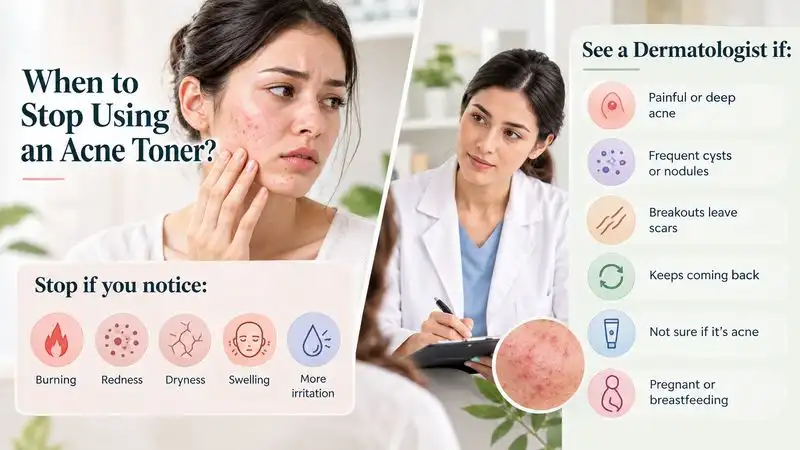
Stop or reduce a toner if you develop significant burning, swelling, persistent redness, severe dryness, or worsening irritation.
Even the best toner for acne-prone skin is not suitable if it causes persistent irritation or discomfort.
Do not assume that painful irritation means the product is “working.”
You should also consider professional dermatology care when acne is deep, painful, persistent, or leaving scars.
The AAD notes that large, painful pimples that sit deep in the skin or acne that leaves scars often require professional treatment because over-the-counter products may not adequately treat them.
Seek professional advice if:
- Acne is painful or deep
- You develop frequent cysts or nodules
- Breakouts leave scars
- Acne keeps returning despite consistent care
- Your skin reacts strongly to multiple products
- You are unsure whether the bumps are actually acne
- You need prescription treatment
- You are pregnant or breastfeeding and want advice about active treatments
A toner cannot replace diagnosis or prescription acne treatment when those are appropriate.
The goal is not to find the strongest toner.
The goal is to create a routine your skin can tolerate and maintain.
Frequently Asked Questions
What is the best toner for acne-prone skin?
The best toner depends on your skin needs. Salicylic acid may help with clogged pores and blackheads, while hydrating toners can suit sensitive or dehydrated acne-prone skin.
Can toner remove acne?
Toner cannot cure acne on its own. Some formulas with salicylic acid may help unclog pores, but persistent or severe acne may need professional treatment.
Is salicylic acid toner good for oily skin?
Yes. Salicylic acid toner may help oily skin with clogged pores, blackheads, and whiteheads. Use it as directed to reduce the risk of dryness and irritation.
Can sensitive acne-prone skin use toner?
Yes. Sensitive skin may benefit from a gentle, hydrating toner. Look for simple formulas and stop using the product if it causes persistent burning, redness, or peeling.
How often should I use toner for acne-prone skin?
It depends on the formula. Hydrating toners may be used more often, while exfoliating toners may need less frequent use. Always follow the product directions.“
Conclusion
Choosing the best toner for acne-prone skin depends on your skin type and main concern. Salicylic acid may help with clogged pores and blackheads, while gentle hydrating toners can suit sensitive or dehydrated skin.
Avoid harsh formulas and using too many active ingredients at once. Introduce new products slowly, moisturize regularly, and use broad-spectrum sunscreen.
If your acne is painful, persistent, or leaving scars, consider speaking with a dermatologist.
For healthier-looking skin, focus on a simple, gentle, and consistent skincare routine rather than using the strongest products.





Leave a Reply